Product Overview
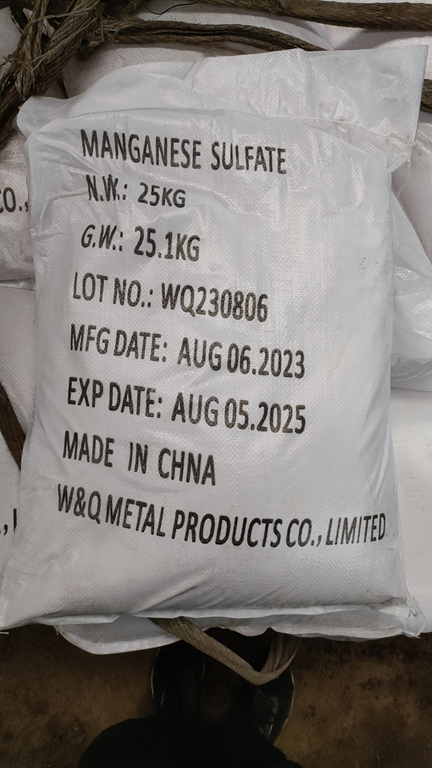
W&Q's Manganese Sulfate Monohydrate (molecular formula: MnSO₄·H₂O) is a high-purity inorganic compound, appearing as pale pink crystalline powder with excellent water solubility and stability. As an essential trace element, manganese plays a vital role in enzyme activation, bone formation, and metabolic regulation for humans, animals, and plants. W&Q produces manganese sulfate monohydrate in accordance with strict GMP and ISO standards, adopting refined purification processes and high-quality raw materials to ensure consistent purity, low heavy metal content, and reliable performance. Our product is widely used in animal nutrition, plant fertilizers, food supplements, and pharmaceutical fields, delivering a premium manganese source for global clients.
Product Benefits
1. Enzyme Activity Regulation: Manganese is a key cofactor for numerous enzymes, including superoxide dismutase (SOD), arginase, and pyruvate carboxylase. These enzymes are involved in antioxidant defense, protein synthesis, and energy metabolism. W&Q’s manganese sulfate monohydrate ensures high bioavailability, effectively supporting enzymatic reactions and maintaining normal physiological functions.
2. Animal Growth Promotion: For livestock and poultry, adequate manganese supplementation improves bone development, enhances reproductive performance, and boosts immune function. It helps prevent manganese deficiency-related diseases such as perosis (leg weakness) in poultry and poor fertility in mammals, contributing to higher feed conversion rates and production efficiency.
3. Plant Nutrient Enhancement: As a critical micronutrient for plants, manganese promotes chlorophyll synthesis, photosynthesis, and nitrogen metabolism. It enhances crop resistance to diseases and environmental stress, improving yield and quality. W&Q’s product is easily absorbed by plants, suitable for both soil application and foliar fertilization.
4. Human Health Support: For humans, manganese aids in bone mineralization, brain development, and carbohydrate metabolism. It also strengthens the antioxidant system, helping to reduce oxidative damage. Appropriate supplementation is beneficial for maintaining bone density and neurological health, especially for vulnerable groups such as children and the elderly.
Usage
- Animal Nutrition: Added to livestock and poultry feed. The recommended dosage varies by species and growth stage: 50-100 mg/kg for poultry feed, 40-80 mg/kg for swine feed, and 30-60 mg/kg for ruminant feed. W&Q provides tailored dosage guidance based on specific breeding needs.
- Agricultural Fertilizers: Used as a micronutrient fertilizer for crops such as wheat, rice, corn, and fruits. For soil application, the dosage is 10-20 kg/ha; for foliar spray, dilute to a 0.05-0.1% solution and apply during the seedling and flowering stages.
-Food & Pharmaceutical Supplements: Used in multivitamin-mineral formulations. The daily recommended intake for adults is 1.8-2.3 mg of manganese (equivalent to appropriate manganese sulfate monohydrate content). Dosage should be adjusted based on age, health status, and dietary intake.
Storage: Store in a dry, cool, and well-ventilated warehouse, away from moisture, direct sunlight, and alkaline substances. Keep sealed to prevent caking and deterioration. Shelf life is 24 months under proper storage conditions.
FAQ
Q1: Is manganese sulfate monohydrate harmful to humans or animals?
A1: Manganese is essential but toxic in excessive amounts. The daily maximum safe intake for humans is 11 mg. Acute poisoning (nausea, vomiting, neurological symptoms) may occur with high-dose ingestion. W&Q’s products are formulated within safe limits, and strict adherence to recommended dosages is advised.
Q2: Can it be mixed with other fertilizers or feeds?
A2: It can be mixed with most water-soluble fertilizers and feeds, except alkaline substances (which may cause precipitation). For large-scale mixing, W&Q recommends conducting a small-scale compatibility test first to ensure stability.
Q3: What is the difference between manganese sulfate monohydrate and anhydrous manganese sulfate?
A3: Monohydrate has a lower manganese content (≈32%) but better stability and water solubility, suitable for most applications. Anhydrous has higher manganese content (≈46%) but is prone to moisture absorption. W&Q’s monohydrate product balances efficacy and storage convenience for mainstream needs.
Q4: Does it meet international quality standards?
A4: Yes. W&Q’s manganese sulfate monohydrate complies with global standards such as USP, BP, FCC, and GB/T 15899-2020, with heavy metal content (Pb, Cd, As) below 10 ppm, fully meeting food, feed, and pharmaceutical grade requirements.
Why Choose W&Q?
1. Strict Quality Control: W&Q implements full-process quality monitoring, from raw material screening to finished product testing. Our manganese sulfate monohydrate has a purity of ≥98%, low impurities, and consistent particle size, ensuring stable performance in various applications.
2. Professional R&D Capabilities: W&Q’s R&D team specializes in optimizing manganese-based products, developing customized formulations for animal, agricultural, and pharmaceutical industries. We continuously upgrade processes to improve bioavailability and cost-effectiveness.
3. Global Regulatory Compliance: Our products are certified by GMP, ISO 9001, FDA GRAS, and EU feed additive regulations, enabling seamless market access in Asia, Europe, North America, and other regions.
4. Comprehensive After-Sales Service: W&Q provides one-stop technical support, including dosage calculation, application guidance, and quality certification documents. Our 24/7 customer team ensures timely solutions to meet diverse client needs.