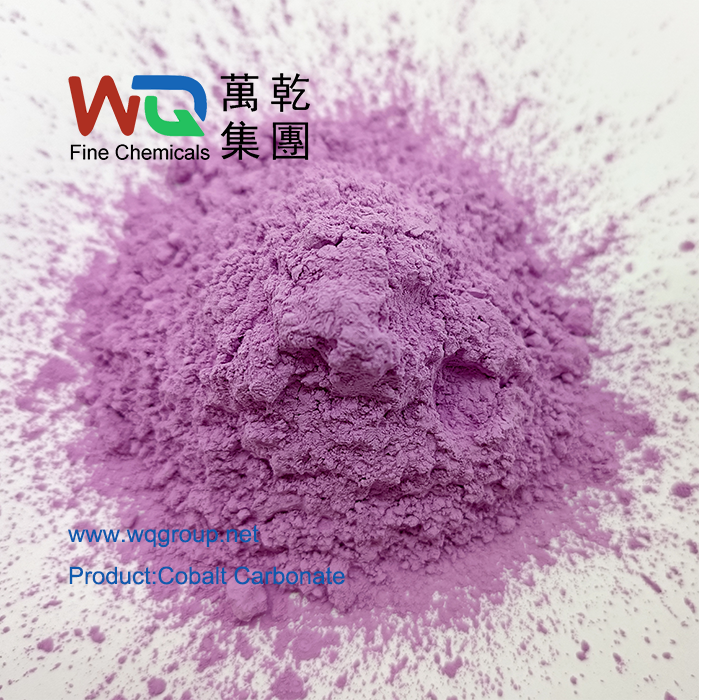
1. Molecular Formula:CoCO₃
2. CAS NO.:513-79-1
3. Molecular Weight:118.94
4. Property: Pink powders, Density:4.13g/cm3 soluble in inorganic acid and liquid ammonia, insoluble in cool water, and decompose in hot water.
5. Sepcification(%):
Industry Grade | Feed Grade |
Co | 46min | Co | 46min; 50min; 52min |
If you need complete technical data and detailed specifications, please contact us directly.
Email: wq@wqgroup.net
WeChat / WhatsApp / Mobile: 0086-13082360769

Product Overview
Cobalt Carbonate (chemical formula: CoCO₃; CAS No.: 513-79-1) is a bright pink, free-flowing powder with a density of 4.13g/cm³ and a molecular weight of 118.94. It exhibits unique solubility properties: soluble in inorganic acids and liquid ammonia, insoluble in cool water, and decomposes in hot water—making it adaptable to diverse industrial processes. We offer two grades to meet specific needs: Industrial Grade and Feed Grade, each with tailored impurity controls. Packaged in 25kg net bags (40 bags per 1000kg pallet) and classified as UN 3077, Class 9, it is designed for safe, efficient handling in industrial and agricultural settings.
Product Benefits
• Consistent Color Performance for Ceramics & Pigments: Our Cobalt Carbonate delivers exceptional color consistency, a critical factor for ceramic glazes and pigment formulations. It imparts a vivid, stable blue hue that remains uniform over time—eliminating batch-to-batch variations for manufacturers.
• Dual-Grade Flexibility: Industrial Grade (with impurities like Cu, Pb, and Fe controlled to 0.003max) suits chemical and coating applications, while Feed Grade (with stricter limits: Pb, Cu, Ni, Cd, As at 0.0005max, Hg at 0.0001max) meets safety standards for animal nutrition. This flexibility lets clients source one product type for multiple needs.
• Optimal Particle Distribution for Catalysts: The free-flowing powder has a uniform particle size, making it an ideal catalyst support for automotive catalytic converters. It ensures maximum surface area for reactions, improving the converter’s efficiency in reducing emissions.
• High Cobalt Content for Cost Efficiency: Both grades maintain a minimum cobalt content of 46%, ensuring clients get maximum value from each shipment. This high metal content reduces the amount of Cobalt Carbonate needed in formulations, lowering overall production costs.
Usage
Ceramic Glazes & Decorative Ceramics
Cobalt Carbonate is a staple in ceramic glaze production, where it creates the sought-after blue color in tableware, tiles, and decorative pieces. Its stability at high firing temperatures (up to 1200℃) ensures the color does not fade or shift, even in industrial kilns. Ceramic manufacturers rely on its consistency to produce repeatable designs for global markets.
Pigments for Paints, Inks & Plastics
In pigment manufacturing, it acts as a coloring agent for oil-based paints, water-based inks, and plastic products. Its bright, opaque hue provides excellent coverage, and its resistance to UV light prevents discoloration in outdoor applications (such as exterior paints or plastic garden furniture).
Catalyst Support in Automotive Industry
As a catalyst support for catalytic converters, Cobalt Carbonate helps stabilize precious metal catalysts (like platinum or palladium) that break down harmful exhaust gases (CO, NOx). Its uniform particle distribution ensures the catalyst operates efficiently throughout the converter’s lifespan.
Feed Additive for Animal Nutrition
Feed Grade Cobalt Carbonate supplies essential cobalt to livestock (such as cattle and sheep), supporting the production of vitamin B12 in their digestive systems. This improves feed conversion rates, boosts animal health, and enhances meat or dairy quality for farmers.
Raw Material for Cobalt Salts & Chemicals
It serves as a precursor for manufacturing other cobalt compounds, including cobalt oxides, cobalt soaps, and cobalt-based dyes. Its high purity reduces purification steps in downstream processes, saving manufacturers time and resources.
FAQ
What is the difference between Industrial Grade and Feed Grade Cobalt Carbonate?
Industrial Grade has looser impurity limits (e.g., 0.003max for Pb, Cu) for industrial use, while Feed Grade has stricter controls (0.0005max for Pb, Cu, Ni) to ensure safety for animal consumption. Always select the grade matching your application.
At what temperature does Cobalt Carbonate decompose?
It decomposes in hot water (typically above 60℃) and begins thermal decomposition at around 200℃, releasing CO₂ and forming cobalt oxide. This property is leveraged in ceramic firing, where decomposition enhances color integration.
Can Cobalt Carbonate be used in water-based paints?
Yes, it is compatible with water-based formulations. Its free-flowing texture disperses easily in water, and its color stability ensures the paint retains its hue without fading or bleeding.
What documentation is included with each order?
Every shipment includes a detailed CoA (Certificate of Analysis) confirming grade, cobalt content, and impurity levels. We also provide transport documents compliant with UN 3077 regulations for international shipping.
Why Choose Us
We stand out as a trusted Cobalt Carbonate supplier by combining quality, expertise, and customer-centric service:
• We use only premium raw materials and the latest manufacturing techniques, with real-time process monitoring to ensure each batch meets or exceeds industry standards.
• Our team of experts offers personalized support—whether you need help selecting the right grade, optimizing formulations, or troubleshooting logistics.
• We provide fast shipping through an efficient logistics network, ensuring your orders arrive on time, even for tight production schedules.
• With a focus on “customer trust and corporate values,” we prioritize transparency—sharing production insights and quality data to help you make informed decisions.
• Our competitive pricing balances quality and cost, ensuring you get a high-performance product without overstretching your budget.