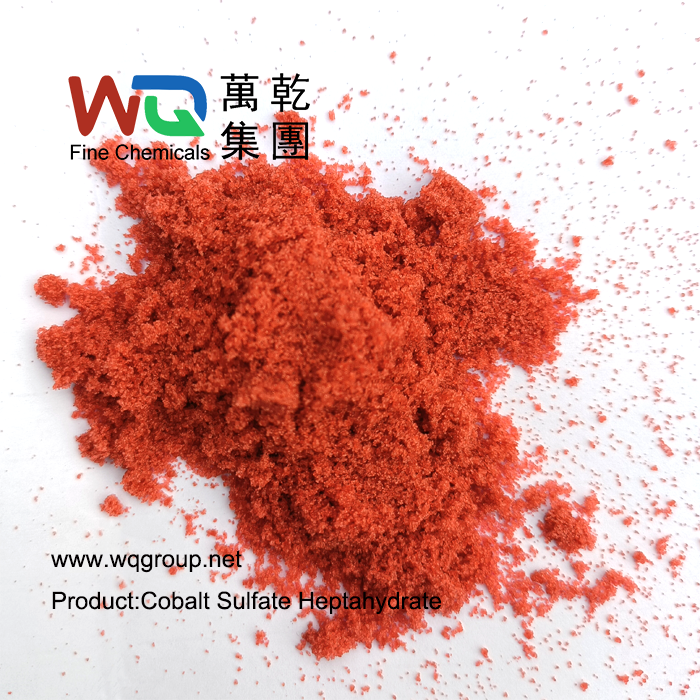
1. Molecular Formula: CoSO4.7H2O
2. Property: Brown yellow or red crystal, density: 1.948g/cm3, melting point:96.8°C, freely soluble in water and methanol, slightly soluble in ethanol. It rime into anhydrous compound at 420°C
3. Sepcification(%): Co21min
If you need complete technical data and detailed specifications, please contact us directly.
Email: wq@wqgroup.net
WeChat / WhatsApp / Mobile: 0086-13082360769
4.CAS:10026-24-1
![Cobalt Sulfate Heptahydrate3]()
Product Overview
W&Q's Cobalt(II) sulfate heptahydrate is the most common hydrated form of cobalt sulfate, easily recognized by its distinctive rose-red or pink crystalline appearance. Its chemical formula is CoSO₄·7H₂O, indicating that each unit of cobalt sulfate is associated with seven water molecules.
Product Benefits
1. Superior Bioavailability and Reactivity
As a highly water-soluble salt, it provides cobalt in the readily bioavailable Co²⁺ ionic form. This ensures rapid and efficient uptake in applications such as animal feed (for vitamin B12 synthesis) and as a micronutrient in fertilizers, leading to optimal biological response and effectiveness.
2.Established Industrial Versatility
3. Optimal Physical Form for Handling
Under standard conditions, the heptahydrate form is stable and non-hygroscopic compared to lower hydrates, which can attract moisture. Its crystalline, free-flowing nature facilitates easier weighing, transportation, storage, and dissolution in manufacturing processes, reducing operational complexities and waste.
4. Cost-Effectiveness and Supply Chain Efficiency
Being the most commonly produced hydrate, it benefits from economies of scale, making it the most cost-effective cobalt source per unit of cobalt content for most applications.
Its widespread production and standardization ensure readily available supply and a robust global logistics chain.
5. Precise and Consistent Quality
Reputable manufacturers supply it with high and consistent purity levels and well-defined specifications (e.g., exact cobalt percentage, low impurities like nickel or iron). This predictability is crucial for maintaining the quality and performance of end-products, especially in sensitive applications like battery chemistry.
6. Regulatory Acceptance
It is an approved and recognized additive in animal nutrition (e.g., listed by the Association of American Feed Control Officials, AAFCO), providing legal certainty and trust for feed manufacturers.
Usage
Electroplating & Surface Treatment: A key component in plating baths to produce durable, decorative, and corrosion-resistant cobalt or cobalt-alloy coatings.
Battery Manufacturing: An essential precursor in the synthesis of cathode materials (like lithium cobalt oxide) for rechargeable lithium-ion batteries, powering consumer electronics and electric vehicles.
Animal Nutrition: An approved nutritional supplement in animal feed to prevent cobalt deficiency, which is necessary for the synthesis of vitamin B12 in ruminants.
Pigments and Driers: Used in the production of blue and green ceramic glazes, glass, and paints. It also acts as a drying agent (siccative) in inks and varnishes.
Chemical Synthesis: Employed as a starting material or catalyst in various chemical reactions and laboratory preparations.
FAQ
Why W&Q think that the heptahydrate form (7H₂O) is more common than the anhydrous form?
The heptahydrate is the stable crystalline form under standard room temperature and humidity conditions. It offers better handling properties (less dusty, easier to dissolve) and is more cost-effective to produce and store for general use. The anhydrous form is more hygroscopic (absorbs moisture from air) and is typically specified only for specific chemical synthesis where water must be excluded.
What does "Rose-red crystals" mean for product quality?
The characteristic rose-red or pink color is a primary visual indicator of product purity and correct chemical identity (the presence of the [Co(H₂O)₆]²⁺ ion). Significant deviation from this color (e.g., brownish or grayish tints) may indicate oxidation or contamination with impurities like iron or nickel.
What are the critical specifications to check when ordering?
Cobalt (Co) Content: Typically 20-21% (on a metallic basis).
Purity/Assay: Expressed as % CoSO₄·7H₂O (often ≥ 98% or higher).
Impurity Limits: Maximum levels for elements like Nickel (Ni), Iron (Fe), Manganese (Mn), Lead (Pb), Arsenic (As), and Cadmium (Cd), which are crucial for battery and feed applications.
Solubility: Should be fully soluble in water, leaving no residue.
Physical Appearance: Uniform, free-flowing crystals.
Is it suitable for use in animal feed? Are there regulatory approvals?
Yes, high-purity grades are specifically manufactured for feed applications. It is listed as an approved nutritional source of cobalt by major regulatory bodies such as the Association of American Feed Control Officials (AAFCO) in the U.S. and under EU regulations on feed additives. Always ensure you are purchasing a "Feed Grade" certified product for this purpose.
Why Choose Us
W&Q stand out as a leading supplier of Cobalt sulfate, backed by our expertise in fine chemicals and customer focus:
• We offer a full product line of cobalt, nickel, copper, fluoride, tungsten, and rare earth compounds—so you can source all your industrial chemicals from a single, reliable supplier.
• Our team includes professional technical personnel who provide tailored support, from helping you optimize rubber formulations to troubleshooting application issues.
• We adhere to the business philosophy of “breaking old rules and embracing innovation,” constantly improving our production processes to enhance product quality and reduce costs.
• We provide excellent after-sales service, ensuring you are satisfied with your order—if you have questions or concerns, our team responds promptly.
• With over 40 key products covering industry, agriculture, pharmacy, and feed sectors, we understand the unique needs of rubber manufacturers and can adapt to your specific requirements.