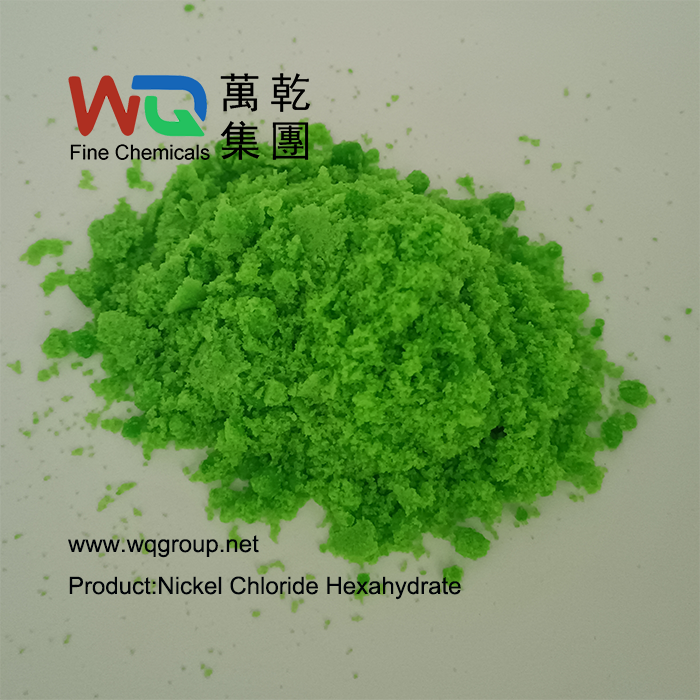
1. Molecular Formula: NiCl₂·6H₂O
2.CAS NO.:7719-20-0
3. Property: Green crystals with specific gravity of 1.921, soluble in water and ethanol, deliquescent in moist air.
4.Molecular Weight:237.69
5. Sepcification: Ni24%min
If you need complete technical data and detailed specifications, please contact us directly.
Email: wq@wqgroup.net
WeChat / WhatsApp / Mobile: 0086-13082360769
![Nickel Chloride Hexahydrate]()
Product Overview
W&Q's nickel chloride hexahydrate is an inorganic salt with the chemical formula NiCl₂·6H₂O (CAS No.: 7791-20-0) . It is a primary source of nickel ions (Ni²⁺) and typically appears as green crystalline powder or granular crystals . It is highly soluble in water and ethanol, and its aqueous solutions are slightly acidic with a pH range of 4.0-6.0 (50g/L, 25℃) .
Product Benefits
1.Physical & Handling (vs. Anhydrous Form):
Moderate Hygroscopicity & Stability: The hexahydrate form has mild moisture absorption and remains stable under sealed conditions. Unlike anhydrous nickel chloride, which easily absorbs moisture and cakes, it maintains free-flowing properties during storage and use .
Uniform Crystalline Structure: Produced as consistent, free-flowing crystals, ensuring easy weighing, accurate dosing, and convenient operation in industrial and laboratory settings .
Controlled Solubility: Rapidly dissolves in both cold and hot water with a predictable solubility profile, ideal for preparing electroplating baths, disinfectant solutions, and ammonia absorption agents .
2.Functional & Performance:
High-Purity Nickel Source: Completely dissociates in aqueous solutions to release Ni²⁺, the active form for electroplating, disinfection, and complexation reactions .
Usage
-
Disinfection: Diluted solutions are used for industrial circulating water disinfection and equipment surface sterilization, effectively inhibiting the growth of harmful microorganisms .
-
Ammonia Absorbent: Applied in industrial waste gas treatment and gas masks to absorb ammonia, preventing air pollution and ensuring workplace safety .
-
Catalysis & Chemical Manufacturing: Key raw material for preparing nickel-based catalysts, dry batteries, and invisible ink .
-
Metal Processing: Added in aluminum alloy chemical polishing to enhance surface smoothness and polishing quality .
-
Laboratory & Analytical Chemistry: Used as a reagent for complexometric titration and qualitative analysis of metal ions .
FAQ
What are the key storage precautions?
How to treat wastewater containing nickel chloride?
What is the difference between nickel chloride hexahydrate and nickel sulfate hexahydrate in electroplating?
What key indicators should be checked on the Certificate of Analysis (CoA)?
Heavy Metal Impurities: Limits for Fe (≤0.001%), Cu (≤0.001%), Pb (≤0.001%), Cd (≤0.001%) (critical for electroplating and high-purity applications) .
Why Choose Us
W&Q stand out as an innovative leading supplier of nickel chloride hexahydrate, backed by professional expertise in fine metal chemicals and customer-centric solutions:
• We offer a one-stop sourcing solution—covering high-purity nickel chloride hexahydrate (electroplating/analytical/industrial grades) and supporting chemicals (nickel sulfate, cobalt chloride, corrosion inhibitors)—so you can streamline procurement and reduce supply chain risks .
• Our R&D team develops application-specific formulations: for example, low-impurity grade for precision electroplating (meets electronics industry standards) and fast-dissolving grade for ammonia absorption systems, tailored to your unique production needs .
• We adopt green production technology—using closed-loop recycling systems to reduce wastewater emission and energy consumption, ensuring our products comply with global environmental standards (REACH, RoHS) while maintaining cost competitiveness .