High-purity materials are not just technical specifications. They act as primary drivers of manufacturing yield and end-product viability. You see their direct impact across advanced electronics, optics, and demanding ceramics applications. Sourcing these vital materials requires careful navigation and deep market insight. You must balance required purity grades—often ranging from 4N to 6N—against harsh production realities. Supply chain stability also complicates the entire procurement process, making supplier selection a critical operational risk.
This guide outlines the technical and commercial criteria necessary to evaluate suppliers effectively. We help you specify exact material requirements tailored perfectly for your specific commercial applications. Understanding these parameters ensures you maintain highly consistent production lines. By the end, you will know exactly how to secure robust, high-yield material inputs for your facility.
Key Takeaways
Purity requirements (4N–6N) must be strictly matched to the application to avoid overpaying for unnecessary refinement or suffering yield losses from trace impurities.
Evaluating a supplier requires looking beyond the Certificate of Analysis (CoA) to their batch-to-batch consistency and extraction methodologies.
Selecting specific materials—such as Erbium Oxide for fiber optics or Neodymium Oxide for magnetics—requires aligning particle size and morphology with your downstream processing capabilities.
Secure sourcing demands an assessment of geopolitical supply chain risks and compliance with environmental and sourcing regulations.
Defining Success: How Purity Levels (4N to 6N) Impact Manufacturing Yield
Trace impurities directly degrade optical transparency, magnetic coercivity, and electrical conductivity. These contaminants often include non-rare earth elements and adjacent rare earth metals. When they infiltrate your manufacturing process, they ruin batch yields and destroy product performance. You must understand the "N" classification system to prevent these expensive production failures.
The "N" denotes the number of nines in the overall purity percentage. Each step up the purity ladder removes exponentially more trace elements.
4N (99.99%) serves as the industry standard for high-performance ceramics and standard electronics. It provides sufficient baseline purity for applications where minute trace elements do not disrupt macroscopic physical properties. Engineers often specify 4N for structural components and basic dielectric formulations.
5N (99.999%) becomes mandatory for specialized optical coatings and advanced phosphors. At this tier, eliminating specific transition metals prevents unwanted light absorption. Displays and laser optics rely entirely on 5N materials to maintain strict luminous efficacy.
6N (99.9999%) remains reserved for ultra-sensitive semiconductor manufacturing and specialized quantum applications. Even parts-per-billion level contaminants will destroy delicate semiconductor lattice structures. Sourcing 6N materials requires working with highly specialized refining facilities.
The cost-to-benefit ratio shifts drastically between these tiers. The exponential cost increase of extraction and refinement from 4N to 6N demands careful budgeting. You need a rigorous framework for calculating acceptable impurity thresholds. Do not buy 6N material if a 5N specification satisfies your engineering tolerance.
Application and Purity Classification Matrix
| Purity Level | Percentage | Primary Contaminant Concern | Typical Application |
| 4N | 99.99% | Heavy metals (Fe, Cu) | Structural ceramics, magnets |
| 5N | 99.999% | Adjacent rare earth elements | Optical coatings, phosphors |
| 6N | 99.9999% | Parts-per-billion trace atoms | Semiconductors, quantum tech |
Best Practice: Always request a breakdown of the specific impurities removed at the 5N and 6N levels. Some refiners focus on removing specific problem elements rather than achieving across-the-board reduction.
![Rare Earth Oxide Pallet]()
Matching Specific Rare Earth Oxides to Commercial Applications
Different commercial applications require distinct compounds. Rare Earth Oxides offer highly tailored physical and chemical properties. You must align your procurement strategy with the specific functional requirements of your end product.
Neodymium Oxide (Nd2O3)
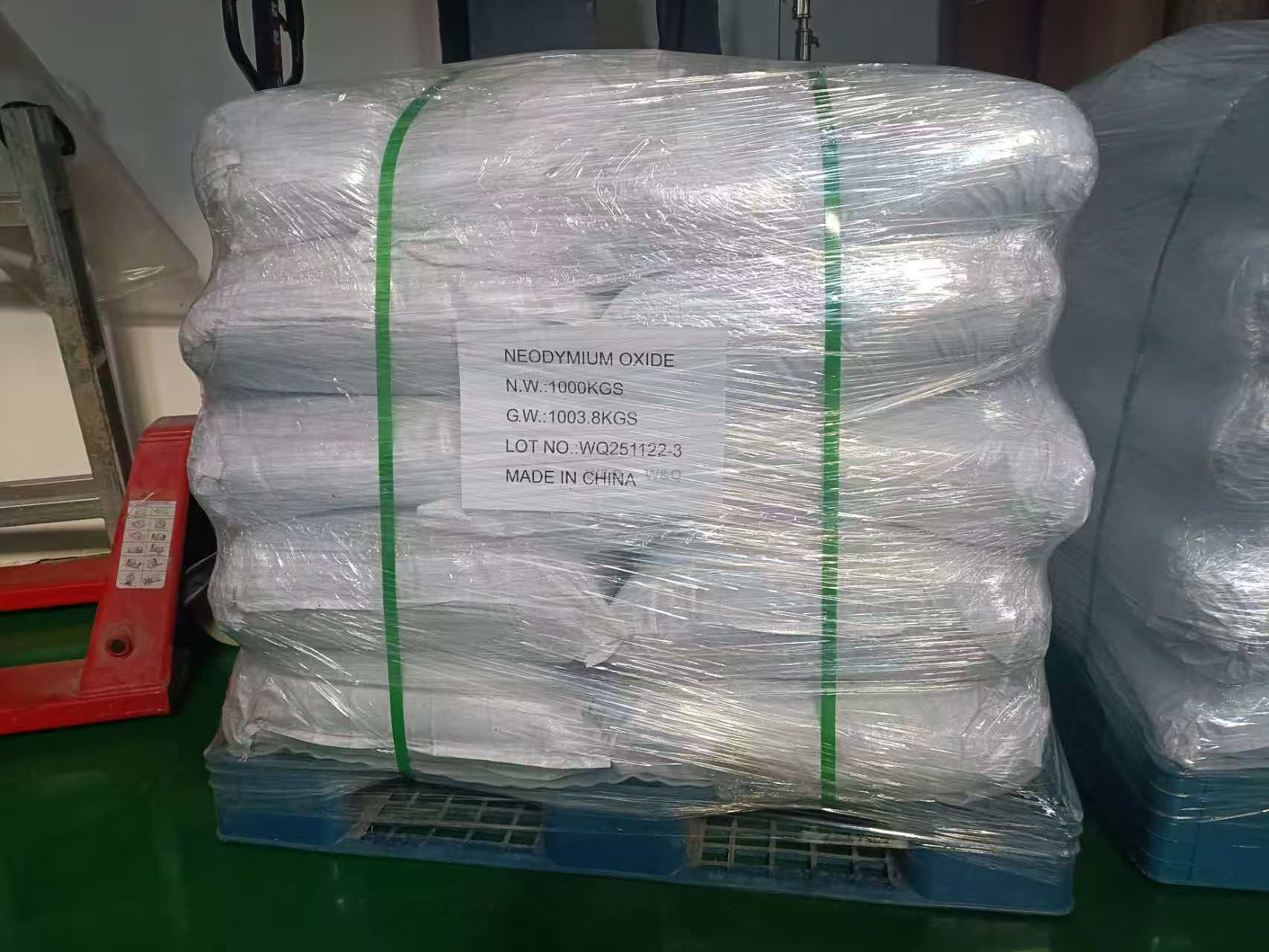
Manufacturers rely heavily on Neodymium Oxide for high-strength permanent magnets (NdFeB). It also serves as a critical component in specialty glass coloration and advanced ceramic capacitors. When evaluating suppliers, you must enforce strict limits on Praseodymium (Pr) and Iron (Fe) impurities. Excessive Praseodymium alters the magnetic moment, while Iron contamination can induce unwanted localized corrosion inside the sintered magnet. Keeping these trace elements negligible ensures high magnetic coercivity and long-term durability.
Yttrium Oxide (Y2O3)
Engineers utilize Yttrium Oxide extensively in thermal barrier coatings and display phosphors. It also functions as the primary stabilizing agent in Zirconia. The key evaluation metric for this compound is the particle size distribution (PSD). Uniform coating applications require predictable, narrow particle size ranges. If the PSD fluctuates wildly, you will experience uneven plasma spraying or inconsistent stabilization in structural ceramics. Tight PSD controls prevent catastrophic thermal cracking in high-temperature environments.
Cerium Oxide (CeO2)
Industries depend on Cerium Oxide for precision glass polishing, particularly in Chemical Mechanical Planarization (CMP) slurries. It also plays a massive role in automotive catalytic converters and solid oxide fuel cells. The most critical evaluation metrics are abrasive uniformity and specific surface area (BET). In CMP applications, oversized particles cause severe micro-scratching on silicon wafers. High BET surface areas increase catalytic reactivity, making the compound much more effective in emissions control.
Erbium Oxide (Er2O3)
Telecommunication companies utilize Erbium Oxide for optical fiber amplification (EDFAs). It also drives tunable lasers and precision medical laser systems. The absolute minimization of transition metal impurities remains the key evaluation metric. Trace metals cause severe signal attenuation by absorbing photons at the operating wavelengths. For optical amplification to function efficiently, the oxide must achieve near-perfect optical transparency, demanding exceptional refinement processes.
Essential Evaluation Criteria for Rare Earth Oxide Suppliers
Securing high-quality material requires looking far beyond a basic product brochure. You must implement aggressive supplier evaluation frameworks to protect your manufacturing processes.
Analytical Testing Rigor
Never rely on unverified baseline Certificates of Analysis (CoAs). You must demand rigorous verification via Inductively Coupled Plasma Mass Spectrometry (ICP-MS) or Glow Discharge Mass Spectrometry (GDMS). These advanced spectroscopic methods detect impurities down to the parts-per-billion level. Suppliers who hesitate to provide raw ICP-MS data often hide inconsistent refinement results.
Batch-to-Batch Consistency
A single good sample means very little. You need to know how to structure pilot testing to verify long-term consistency. Ask the supplier to provide data from five distinct production runs. Suppliers must prove tight standard deviations in both purity and morphology across multiple metric-ton deliveries. Minor fluctuations between batches can force you to recalibrate your entire production line weekly.
Traceability and Documentation
Transparent lot tracking forms the backbone of reliable procurement. You need full visibility from initial mineral extraction through the final calcination process. If a defect occurs downstream, precise lot documentation allows you to isolate the contaminated batch immediately. Good traceability also guarantees the material matches the provided chemical profile.
Red Flags to Avoid
Watch out for several prominent warning signs during procurement:
Unreasonably low pricing: High-purity refinement requires massive energy and chemical inputs. Prices significantly below market average usually indicate cut corners.
Refusal of third-party verification: If a vendor blocks independent lab testing, they likely know their material fails specifications.
Opaque extraction origins: Hidden supply chains often point to illegal mining operations or inconsistent raw material sources.
Common Mistake: Relying solely on a supplier's internal CoA without conducting a blind test through an independent laboratory during the initial qualification phase.
Technical Specifications Beyond Purity: Morphology and Reduction Agents
Many procurement teams focus entirely on chemical purity. However, physical characteristics often dictate whether the material actually works in your facility.
Particle Size Distribution (PSD) & Morphology
Chemical purity alone is insufficient if the oxide cannot be uniformly dispersed, sintered, or reduced. Particle Size Distribution (PSD) measures the variation in physical grain sizes. If you purchase material with large, blocky agglomerates, it will not dissolve evenly in acid baths. In ceramic sintering, varied particle morphologies cause uneven shrinkage, leading to warped or fractured components. You must specify exact D50 and D90 parameters to ensure the material flows and packs correctly in your molds.
Specific Surface Area (BET)
The Specific Surface Area, measured via the BET method, dictates the reactivity of the powder. A high BET value means the powder has extensive porosity and surface area. This characteristic heavily impacts downstream chemical processes. For catalytic applications, you want high BET values to maximize reaction sites. For dense ceramic applications, you often want lower BET values to reduce powder friction and improve green-body density prior to firing.
Reduction Considerations
If you intend to convert the oxide into a pure metal, you must assess how it interacts with common reduction agents. Metallization processes typically utilize Calcium or Aluminum as reducing agents. You must evaluate the risk of secondary contamination during this high-temperature reduction. If your oxide powder contains moisture or highly reactive surface compounds, it will react violently or form undesirable slag. Understanding these thermochemical dynamics helps you tailor the exact calcination state required from your supplier.
Mitigating Supply Chain Risks and Ensuring Compliance
Securing a reliable flow of raw materials requires diligent risk management. The global market remains highly concentrated, making supply chain resilience a mandatory business practice.
Geopolitical Resilience
You cannot rely on a single geographic region for critical materials. Strategies for qualifying secondary or tertiary suppliers must be implemented early. Establishing relationships with refiners across different continents insulates your production lines from sudden export bans or regional trade disputes. Building a diversified supplier portfolio takes time but prevents catastrophic factory shutdowns.
Environmental & Extraction Compliance
Evaluating the supplier's environmental footprint is no longer optional. You must source from manufacturers utilizing modern, low-emission solvent extraction and advanced ion-exchange protocols. Older, unregulated facilities generate massive amounts of toxic wastewater and radioactive tailings. Partnering with environmentally negligent suppliers exposes your brand to severe public relations crises and sudden regulatory closures.
Regulatory Alignment
Your materials must meet strict international standards before entering global markets. Ensure full compliance with REACH (Registration, Evaluation, Authorisation and Restriction of Chemicals) regulations for European markets. You must also verify RoHS (Restriction of Hazardous Substances) compliance, especially for electronics applications. Finally, demand strict adherence to conflict-mineral reporting standards. Ethical sourcing documentation proves your materials do not fund armed conflict, protecting you during rigorous vendor audits.
Conclusion
Sourcing high-purity rare earth materials is fundamentally an exercise in operational risk mitigation. You must balance complex technical specifications, such as extreme purity limits and tight PSD controls, with vendor reliability. Looking beyond the basic CoA to verify testing transparency and supply chain security ensures long-term manufacturing stability. Your success depends entirely on aligning the chemical and physical traits of the powder with your precise downstream processes.
Next Steps for Procurement:
Define the exact maximum tolerance for critical impurities based on your specific application limits.
Request representative sample batches accompanied by raw ICP-MS reports from the supplier.
Initiate comprehensive pilot runs to verify processing compatibility before locking into long-term volume contracts.
FAQ
Q: What is the difference between TREO and REO purity?
A: Total Rare Earth Oxides (TREO) measures the combined mass of all rare earth elements present in the sample. REO purity refers to the specific purity of the individual targeted oxide (like Erbium Oxide) relative to the other rare earth elements inside that TREO baseline. You need high REO purity to ensure the specific element dominates.
Q: Why does particle size matter if the rare earth oxide will be melted or dissolved?
A: Inconsistent particle sizes drastically alter dissolution rates. Fine particles dissolve rapidly, while large agglomerates resist acid attack, leaving unreacted sludge. In melting processes, varying sizes create uneven thermal profiles. This causes localized overheating, excessive energy consumption, and inconsistent dispersion within molten slurries.
Q: Can 4N purity be upgraded to 5N in-house?
A: Generally, no. Upgrading from 4N to 5N requires highly specialized refining techniques like fractional crystallization or advanced, multi-stage solvent extraction. These processes demand massive infrastructure, toxic chemical handling, and extreme precision. The prohibitive cost and technical difficulty make pre-refined sourcing the standard industry practice.
Q: How do impurities in Yttrium Oxide affect thermal barrier coatings?
A: Trace elements in the oxide disrupt the stable crystal lattice of the coating. During rapid high-temperature cycling in gas turbines, these impurities cause premature phase destabilization. The coating undergoes unwanted volumetric changes, leading to micro-cracking, delamination, and ultimately, catastrophic thermal failure of the underlying metal component.