Telecommunications infrastructure and advanced optical systems rely heavily on precise material inputs. Most notably, the unique photoluminescent properties of specific chemical compounds drive these global technologies. Engineers and procurement teams must align closely during the sourcing phase. In rigorous engineering evaluations, sourcing the correct grade of Erbium Oxide is never a simple commercial decision. Instead, it acts as a critical performance variable. This material dictates signal integrity in fiber optics. It also ensures spectral accuracy in specialty glass manufacturing. If you choose the wrong purity, you risk catastrophic signal loss or severe optical distortion. This guide outlines the core commercial applications of this essential material. We detail the technical evaluation criteria needed for specific manufacturing use cases. Furthermore, we provide a structured framework for mitigating supply chain risks when you shortlist reliable vendors.
Key Takeaways
Fiber Optic Amplification: Erbium-Doped Fiber Amplifiers (EDFAs) rely on high-purity (99.99%+) Erbium Oxide to amplify optical signals precisely at the 1550 nm wavelength, minimizing long-haul data loss.
Specialty Glass & Lasers: Beyond acting as an exceptionally stable pink colorant for aesthetic and filter glass, Er₂O₃ is essential for erbium-doped solid-state lasers used in medical and dental applications.
Evaluation Mandates: Procurement decisions must weigh Purity (Trace Elemental Analysis), Particle Size Distribution (PSD), and batch-to-batch consistency over base pricing alone.
Risk Mitigation: Verifying supplier Certificates of Analysis (CoA) and navigating rare-earth supply chain volatility are critical steps before scaling production.
1. Erbium Oxide in Fiber Optics (EDFA Systems)
The Business Problem Framing
Long-distance fiber optic networks suffer from inevitable signal attenuation. Light simply loses intensity as it travels through thousands of kilometers of silica fibers. Historically, engineers fixed this problem by installing electronic repeaters at regular intervals. These traditional repeaters are expensive to install and maintain. They introduce unwanted latency into the network. Furthermore, they reduce overall network reliability. Electronic amplification requires converting optical signals into electrical ones. You must then convert them back to light. This complex, multi-step process creates severe data bottlenecks.
The Application Reality
To solve this problem, manufacturers developed Erbium-Doped Fiber Amplifiers (EDFAs). The application reality relies entirely on advanced chemistry. You dope silica glass fibers using specific rare-earth compounds. Erbium ions ($Er^{3+}$) possess highly specific energy levels. They absorb incoming pump light at 980 nm or 1480 nm wavelengths. After absorbing this energy, they emit stimulated radiation exactly at the 1550 nm window. This emission matches the exact wavelength where silica optical fibers experience the lowest transmission loss. The result is seamless, all-optical signal amplification. Transoceanic submarine networks rely entirely on this technology to function. Without it, global internet traffic would grind to a halt.
Performance Evaluation
Performance evaluation requires strict material standards. Trace impurities degrade signal amplification significantly. If another Rare Earth element contaminates the batch, it will quench luminescence. Transition metals cause similar catastrophic failures. They absorb the very light you want to amplify. Therefore, sourcing criteria typically mandates extreme purity. Telecommunications applications require a minimum of 4N (99.99%) to 5N (99.999%) purity. You cannot compromise on these specifications. Lower grades simply will not perform in long-haul networks. Engineers must reject batches containing even microscopic levels of iron or copper. These contaminants completely ruin the optical gain profile.
2. Applications in Specialty Glass and Laser Manufacturing
Solid-State Lasers (Medical & Industrial)
Erbium-doped glass lasers operate precisely at the 2940 nm wavelength. This specific wavelength achieves a highly targeted clinical outcome. Human tissue contains a high percentage of water. Water absorbs the 2940 nm wavelength exceptionally well. Because of this absorption rate, it becomes a non-negotiable input for precision medical devices. Erbium-YAG (Er:YAG) lasers represent the gold standard in clinical care. Dermatologists rely on these lasers for delicate skin resurfacing. Dentists use them for precise enamel cutting. The targeted energy minimizes thermal damage to surrounding healthy tissue. It ensures much faster patient recovery times. Industrial manufacturers also use these lasers for micro-machining materials. The short pulse duration prevents heat distortion in delicate substrates.
Glass Coloration and UV Filtration
Beyond laser applications, manufacturers use it extensively for coloration. It imparts a stable, distinct pink tint to various materials. You will frequently see this in aesthetic glass and cubic zirconia. Organic dyes fade over time. Rare-earth oxides do not. They maintain excellent color stability under high UV exposure. They also withstand extreme temperature fluctuations during manufacturing. This makes the material highly desirable for rugged industrial applications. It is heavily utilized in high-end photographic filters. Radiation-shielding glass also depends on it. Spectral absorption characteristics must remain uniform in these demanding environments. When creating protective eyewear for welders, manufacturers blend it to absorb specific infrared wavelengths. This provides critical eye protection while maintaining visible spectrum clarity.
![Erbium Oxide Procurement and Storage]()
3. Technical Evaluation Criteria for Sourcing Erbium Oxide
Purity and Impurity Profiling
You must clearly understand the difference between standard and high-purity grades. Standard grades usually sit around 2N (99%) purity. High-purity grades reach 4N or 5N levels. Buyers must demand a comprehensive Certificate of Analysis (CoA) before purchasing. This serves as an evidence-oriented check for your engineering team. The CoA must verify the absolute absence of competing elements. Contaminants like Neodymium or Dysprosium interfere heavily with optical performance. They absorb light and ruin spectral clarity. You should always cross-reference the CoA against your internal material specifications.
Particle Size Distribution (PSD) & Morphology
Homogeneous melting is critical in specialty glass production. You must evaluate the specific surface area carefully. Particle size metrics dictate manufacturing success. The D50 metric shows the median particle size of the powder. These physical traits dictate the dissolution rate inside the furnace. They ultimately determine the final optical clarity of the glass. If particles are too large, they melt unevenly. This creates striations or structural weaknesses in the glass. We recommend requesting laser diffraction reports to verify PSD consistency.
Loss on Ignition (LOI) & Moisture Content
The powder is slightly hygroscopic by nature. It naturally absorbs moisture from the surrounding air. Evaluating the LOI specification is vital during procurement. This ensures you pay for the actual rare earth oxide. You do not want to pay for absorbed water weight. Furthermore, trapped moisture causes catastrophic manufacturing failures. It leads to micro-bubble formation during high-temperature glass firing. Even tiny bubbles render laser glass completely useless.
Erbium Oxide Purity Grade Comparison
| Grade Level | Purity Standard | Primary Application | Moisture Sensitivity |
| Standard | 2N (99%) to 3N (99.9%) | Aesthetic Glass Coloration, Ceramics | Moderate |
| High Purity | 4N (99.99%) | Solid-State Lasers, UV Filtration | High |
| Ultra-High Purity | 5N (99.999%) | EDFA Telecommunications, Fiber Optics | Extremely High (Vacuum sealed) |
4. Implementation Considerations and Operational Risks
Handling and Storage Realities
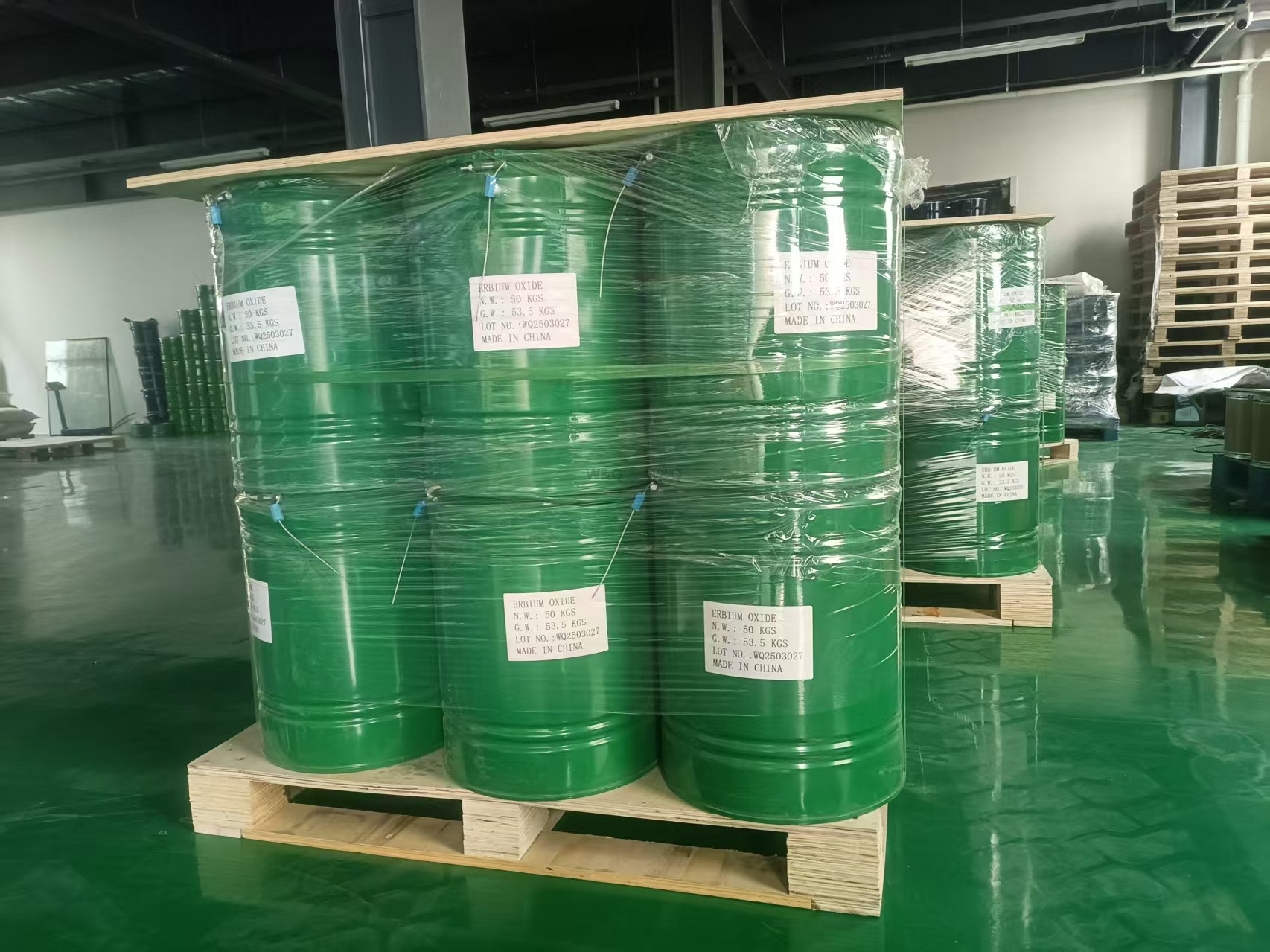
High-purity optical powders are extremely fragile. Due to rapid moisture absorption, improper storage creates immediate problems. It can degrade material performance in a matter of days. You must implement strict climate-controlled warehousing. Vacuum-sealed packaging is absolutely required for 4N+ grades. If you expose the powder to ambient humidity, it clumps together. This agglomeration ruins the homogenous mixing process. We advise keeping the material sealed until the exact moment of batching. Workers should handle it in humidity-controlled dry rooms whenever possible. Maintain relative humidity below 30% in storage areas.
Supply Chain Volatility
Strategic sourcing requires excellent market foresight. As a critical element, erbium pricing is subject to severe geopolitical market fluctuations. Relying strictly on spot-market purchasing introduces severe cost instability to your operations. You must build resilient, long-term supplier relationships. Geopolitical shifts often restrict raw material exports unexpectedly. Strategic stockpiling helps mitigate these sudden disruptions. Diversifying your supplier base across different geographic regions provides an excellent safety net against unforeseen shortages.
Yield Assumptions
Process engineers must model highly accurate yield assumptions. You must account for volatilization losses during production. High-temperature glass melting vaporizes some of the material. Theoretical doping ratios rarely match reality perfectly. You cannot assume a 1:1 retention rate in the furnace. Engineers must calculate the actual retained erbium in the finished matrix. This requires extensive pilot testing. You must perform iterative recipe adjustments to find the optimal doping concentration. Always document these yield variations to improve future forecasting.
5. Shortlisting Suppliers: Next Steps for Procurement
Compliance and Transparency
You must vet your suppliers rigorously before signing contracts. Verify REACH compliance if you operate in or sell to European markets. Ensure your sourcing adheres strictly to international conflict-mineral regulations. Transparent documentation prevents sudden legal or regulatory bottlenecks. A reputable supplier will provide SDS (Safety Data Sheets) and compliance certificates without hesitation. If they delay sending these documents, consider it a major red flag.
Sampling Protocols
Never skip the initial testing phase. Always require a small batch sample from a new vendor. Request 500g to 1kg of material initially. Use this small quantity for lab-scale pilot melting. You must validate the physical properties before committing your budget. Do this before you purchase commercial-scale tonnage. Test the sample for melting behavior, optical clarity, and luminescence. Compare the test results directly against the provided CoA.
Audit Checklist
Ask highly specific questions during vendor facility audits. We recommend using a standardized evaluation matrix to score potential partners.
Do they offer custom milling to meet your specific PSD requirements?
Are they a primary refiner or merely a secondary distributor?
Do they maintain strict in-house analytical laboratories for quality control?
Can they guarantee batch-to-batch consistency over a multi-year contract?
What is their emergency lead time for unexpected demand spikes?
Primary refiners usually offer much better batch-to-batch traceability. They control the raw source material from the ground up. Distributors might mix batches from different refiners, destroying consistency.
Conclusion
Integrating this advanced oxide into manufacturing is complex. It requires balancing strict optical tolerances against real supply chain realities. You might be minimizing signal loss in global telecommunications. Alternatively, you might be manufacturing precision laser glass for medical devices. In any scenario, material purity dictates success. The physical specifications dictate the end-product's absolute viability.
Shift your procurement conversations immediately. Move away from commoditized pricing discussions. Focus entirely on strict metallurgical consistency. Demand optical reliability from your partners. Initiate your vendor shortlisting by requesting recent CoAs. Finally, establish strict pilot-scale testing parameters. Taking these proactive steps ensures high yields and superior optical performance.
FAQ
Q: What purity of Erbium Oxide is required for fiber optic applications?
A: Fiber optic applications (EDFAs) typically require ultra-high purity, strictly defined as 99.99% (4N) or greater, to prevent signal quenching from trace impurities.
Q: Why is Erbium Oxide preferred over other colorants for pink specialty glass?
A: It offers exceptional thermal and UV stability. Unlike metallic or organic colorants, its sharp absorption bands create vibrant, fade-resistant coloration even under harsh environmental conditions.
Q: How does moisture impact Erbium Oxide powder?
A: Er₂O₃ is mildly hygroscopic. Absorbed moisture can cause agglomeration, affecting flowability and homogeneous mixing in glass matrices, and can lead to defects (bubbles) during the melting process.
Q: Are there viable substitutes for Erbium Oxide in telecommunication amplifiers?
A: Currently, no other element matches the efficiency of the Erbium ion's emission at the 1550 nm window, making it practically irreplaceable for long-haul silica fiber amplification.