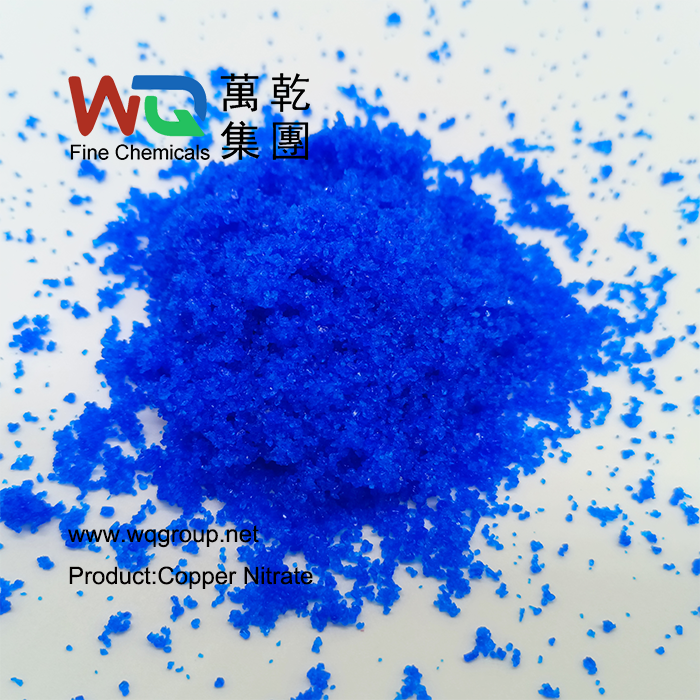
1. Molecular Formula:Cu(NO3)2.3H2O
2. CAS NO.:10031-43-3
3. Molecular Weight:241.60
4. Property: It appears as transparent blue crystalline solid, easy to deliquesce in air.
Highly soluble in water and ethanol; its aqueous solution is weakly acidic.
It has strong oxidizing property. When heated, it decomposes to release toxic nitrogen dioxide gas, and reacts violently or even explodes when mixed with combustibles, reducing agents and organic substances.
5. Sepcification: purity 99%min
If you need complete technical data and detailed specifications, please contact us directly.
Email: wq@wqgroup.net
WeChat / WhatsApp / Mobile: 0086-13082360769

Product Overview
W&Q's Copper nitrate refers to a group of inorganic compounds with the general formula Cu(NO₃)ₙ, where n = 2 (copper(II) nitrate, the most common form) or n = 1 (copper(I) nitrate, unstable and rarely used). The primary commercial form is copper(II) nitrate, usually encountered as the trihydrate (Cu(NO₃)₂·3H₂O) – a blue-green crystalline solid soluble in water, ethanol, and acetone.
Product Benefits
-
High Purity & Stable QualityAvailable in both reagent grade (purity ≥99.8%) and industrial grade (purity ≥99.0%). Rigorous crystallization and purification processes ensure low levels of impurities such as chloride, sulfate and heavy metals, meeting the strict standards of electronics, pharmaceutical and catalyst manufacturing industries.
-
Excellent Solubility & ReactivityHighly soluble in water, ethanol and acetone, forming clear solutions quickly without residues. Its strong reactivity enables easy synthesis of various copper-based compounds (e.g., copper hydroxide, copper carbonate) and coordination complexes, serving as an ideal precursor for chemical production.
-
Convenient Packaging & StorageAdopts standardized export packaging (25kg woven bags with PE liners, 50kg HDPE drums, 1kg reagent bottles) to prevent moisture absorption and contamination. The trihydrate form has good stability under normal storage conditions (cool, dry environment), with a long shelf life of up to 24 months.
-
Compliance with International Safety StandardsClassified and labeled in accordance with UN GHS regulations (Class 5.1 Oxidizing Substance, UN 3077). Complete safety data sheets (SDS) are provided, facilitating customs clearance and safe handling for global customers.
-
Cost-effective Production SolutionThe synthesis process is mature and scalable, with raw materials (copper oxide, nitric acid) easily accessible. Compared with other copper salts (e.g., copper sulfate), it requires less neutralizer in subsequent reactions, reducing overall production costs for downstream users.
Usage
-
Chemical ManufacturingServes as a key precursor for synthesizing various copper-based compounds, including copper hydroxide, copper carbonate, and copper phthalocyanine pigments. It also acts as a catalyst in organic synthesis reactions, promoting the efficiency of esterification, oxidation, and polymerization processes.
-
Electronics IndustryWidely used in electroplating processes to deposit uniform, corrosion-resistant copper coatings on metal substrates. It is an essential material for manufacturing printed circuit boards (PCBs), where it facilitates the formation of conductive copper traces and pads. Additionally, it can be applied in the production of semiconductor materials and electronic components.
-
Agricultural SectorFormulated into low-toxicity fungicides for crops such as grapevines, potatoes, and fruits. These formulations effectively inhibit the growth of fungal pathogens (e.g., downy mildew, late blight) while supplementing trace copper elements necessary for plant photosynthesis and growth. It is also used as a foliar fertilizer in some cases.
-
Laboratory & Analytical ChemistryFunctions as a common analytical reagent for detecting the presence of halide ions (e.g., chloride, bromide) and phosphate ions. It is also utilized in the preparation of coordination complexes for chemical research, and as a staining agent in biological experiments to enhance the visibility of certain cellular structures.
-
Other Industrial Uses
Added to ceramic glazes and glass formulations to produce blue or green hues, improving the aesthetic and functional properties of the final products.
Used in the production of pyrotechnics to create blue-colored flames.
Applied in wastewater treatment to remove sulfide ions and heavy metal contaminants through precipitation reactions.
FAQ
Is copper nitrate soluble in organic solvents?
Yes. Copper nitrate is highly soluble in water, and also dissolves well in polar organic solvents such as ethanol, acetone and methanol. It is nearly insoluble in non-polar solvents like benzene and toluene.
How should copper nitrate be stored to avoid deterioration?
Copper nitrate should be stored in a cool, dry, well-ventilated warehouse at a temperature below 30°C, away from direct sunlight. It must be kept sealed in its original packaging to prevent moisture absorption (which causes deliquescence) and contact with air. Additionally, it should be stored separately from combustibles, reducing agents, acids and alkalis to avoid chemical reactions.
What are the safety precautions for handling copper nitrate?
·Personal Protection: Wear chemical-resistant gloves, safety goggles, a dust mask and protective clothing during operation to prevent contact with skin, eyes and respiratory tract.
·Avoid Hazards: Do not mix with combustible materials (e.g., paper, wood) as it is an oxidizing substance (UN Class 5.1) and may cause fire or explosion if heated or in contact with reducing agents.
·Spill Handling: Sweep up dry spills with inert materials (e.g., sand, vermiculite) and transfer to a designated disposal container. Avoid rinsing spills with water directly, as this may form acidic solutions that corrode equipment or contaminate the environment.
Can copper nitrate be used in organic synthesis?
Absolutely. Copper nitrate acts as an efficient oxidizing catalyst in organic synthesis, widely applied in reactions such as the oxidation of alcohols to aldehydes/ketones, the nitration of aromatic compounds, and the synthesis of coordination complexes. Its high reactivity and solubility make it a preferred reagent for laboratory and industrial organic production.
Why Choose Us
W&Q stand out as a leading supplier of copper nitrate, backed by our expertise in fine chemicals and customer focus:
• We offer a full product line of cobalt, nickel, copper, fluoride, tungsten, and rare earth compounds—so you can source all your industrial chemicals from a single, reliable supplier.
• Our team includes professional technical personnel who provide tailored support, from helping you optimize catalyst to troubleshooting application issues.
• We adhere to the business philosophy of “breaking old rules and embracing innovation,” constantly improving our production processes to enhance product quality and reduce costs.
• We provide excellent after-sales service, ensuring you are satisfied with your order—if you have questions or concerns, our team responds promptly.
• With over 40 key products covering industry, agriculture, pharmacy, and feed sectors, we understand the unique needs of catalyst and can adapt to your specific requirements.